An annular “ring of fire” solar eclipse rises over a beach. During the February 17, 2026 eclipse, the Moon will cover approximately 96% of the Sun’s disk. Credit: NASA/Aubrey Gemignani
What Is Happening on February 17, 2026?
On February 17, 2026, an annular solar eclipse — also known as a “ring of fire” eclipse — will sweep across parts of the Southern Hemisphere. Unlike a total solar eclipse where the Moon completely blocks the Sun, an annular eclipse occurs when the Moon is slightly too far from Earth in its elliptical orbit to fully cover the solar disk. The result is a spectacular ring of sunlight visible around the Moon’s silhouette at maximum eclipse.
This particular eclipse will have a magnitude of 0.9630, meaning the Moon will cover about 96% of the Sun’s surface at the point of greatest eclipse. The remaining 4% will form a brilliant, thin ring of fire around the Moon’s dark outline — a sight that, while not as dramatic as totality, is striking in its own right.
Where Will the Eclipse Be Visible?
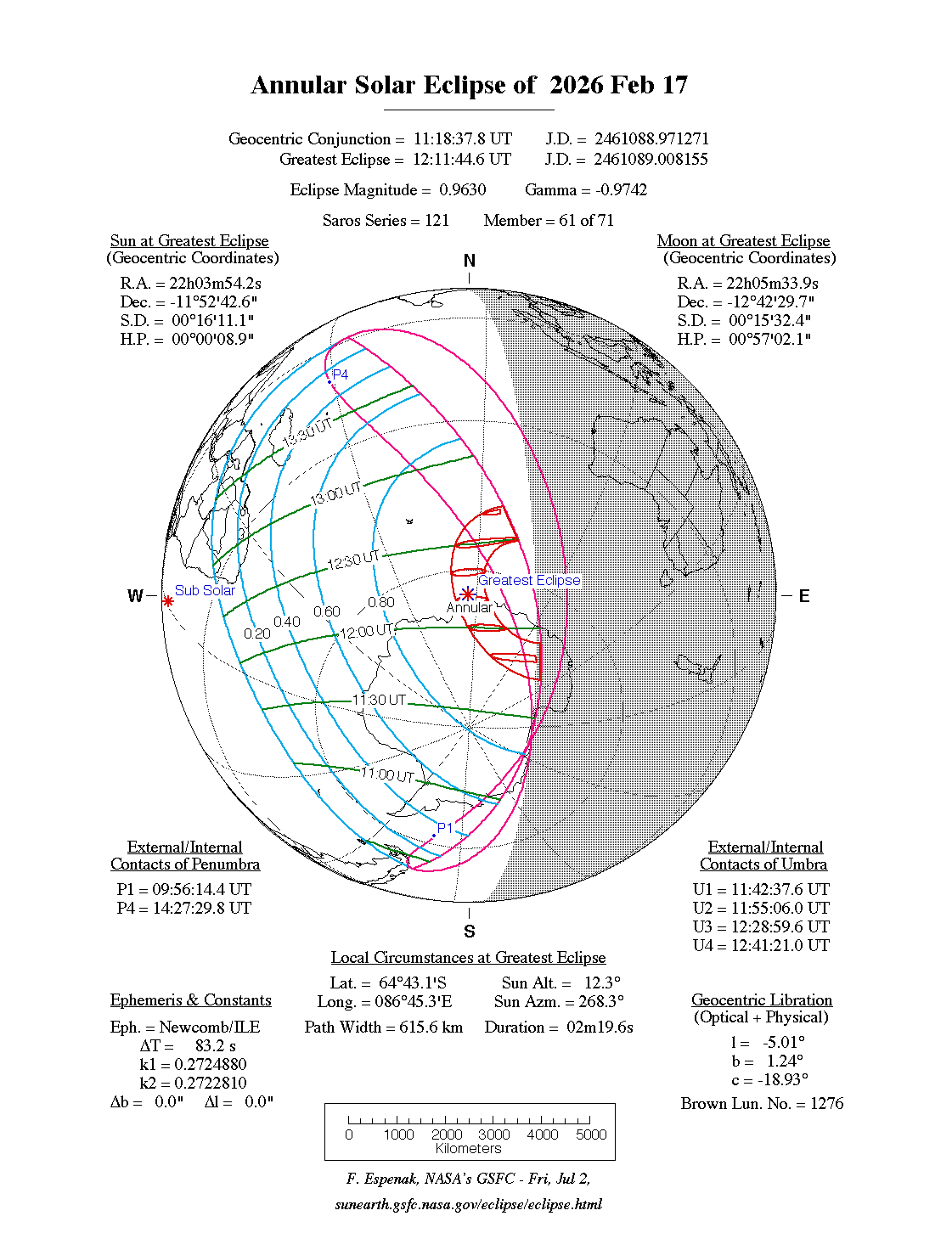
NASA orthographic map showing the path of the February 17, 2026 annular solar eclipse. The dark central band crossing Antarctica marks the path of annularity. Eclipse predictions by Fred Espenak, NASA/GSFC. Public Domain.
This eclipse is primarily a Southern Hemisphere event, with the path of annularity crossing some of the most remote terrain on the planet.
Path of Annularity (The Ring of Fire)
The narrow path where observers can see the full “ring of fire” effect crosses remote Antarctica and the surrounding Southern Ocean. The path is approximately 616 kilometers (383 miles) wide and stretches for about 4,282 kilometers (2,661 miles). Greatest eclipse occurs at 12:12 UTC at coordinates 64.7°S, 86.8°E — deep in the Antarctic interior, far from any permanent settlement.
The maximum duration of annularity is 2 minutes and 20 seconds, occurring near the Antarctic coast where the Sun sits extremely low on the horizon (just above 0° altitude). At the point of greatest eclipse further inland, the ring of fire lasts about 2 minutes and 19 seconds with the Sun at 12.3° above the horizon.
In practical terms, witnessing the full annular phase of this eclipse requires being in Antarctica or on a ship in the Southern Ocean — making it one of the least accessible eclipses of the decade.
Partial Eclipse Visibility
While the ring of fire will be visible only from Antarctica, a partial solar eclipse will be visible from a much wider area. If you are in any of the following regions, you will see the Moon take a bite out of the Sun:
- Southern tip of South America: Observers in Tierra del Fuego, the Falkland Islands, and southernmost Argentina and Chile will see a modest partial eclipse, with the Moon covering roughly 10–30% of the Sun’s disk depending on exact location.
- Southern Africa: South Africa, Namibia, Botswana, Zimbabwe, Mozambique, and Madagascar will see a partial eclipse. The coverage will be relatively small — typically 10–25% of the Sun’s disk — but still noticeable with proper solar viewing equipment.
- Antarctica: Locations outside the path of annularity but on the Antarctic continent will see a deep partial eclipse, with the Moon covering 80–95% of the Sun.
- Southern Indian Ocean: Various island groups including the Kerguelen Islands, Heard Island, and surrounding waters.
This eclipse will NOT be visible from North America, Europe, most of Asia, or Australia.

Animated map showing the Moon’s shadow sweeping across the Southern Hemisphere during the February 17, 2026 annular eclipse. Eclipse predictions by Fred Espenak, NASA/GSFC. Public Domain.
Timeline of the Eclipse (UTC)
| Event | Time (UTC) |
|---|---|
| Partial eclipse begins (first contact with Earth) | 09:56 UTC |
| Annular eclipse begins | 11:42 UTC |
| Maximum eclipse (greatest magnitude) | 12:12 UTC |
| Annular eclipse ends | 12:38 UTC |
| Partial eclipse ends (last contact with Earth) | 14:27 UTC |
The entire event — from the first partial phase touching Earth to the last — spans approximately 4 hours and 31 minutes.
What Is an Annular Eclipse and How Does It Differ from a Total Eclipse?

Sequence showing an annular eclipse progression — the Moon moves across the Sun creating partial phases, then forms the distinctive “ring of fire” at maximum before exiting. Credit: NASA Scientific Visualization Studio
The difference between an annular and a total solar eclipse comes down to the Moon’s distance from Earth at the time of the eclipse.
- Total solar eclipse: The Moon is close enough in its orbit that its apparent size equals or exceeds the Sun’s. It completely blocks the solar disk, revealing the Sun’s corona — the pearly white outer atmosphere visible only during totality. The sky goes dark, stars appear, and temperatures drop. Total eclipses are among the most awe-inspiring natural phenomena a person can witness.
- Annular solar eclipse: The Moon is farther from Earth (near apogee), so its apparent diameter is smaller than the Sun’s. It cannot fully cover the disk, leaving a ring (annulus) of sunlight visible around the Moon’s silhouette. The sky does not go fully dark — it dims noticeably but remains bright enough that the corona is not visible. The ring of fire effect is beautiful but distinctly different from totality.
Because the Sun is never fully blocked during an annular eclipse, it is never safe to look at directly without proper solar protection — unlike the brief window of totality during a total eclipse.
How to Observe Safely
If you are in a region where the partial eclipse is visible, you must use proper eye protection. Looking at the Sun without a solar filter (see the AAS eye safety guide) — even when most of the disk is covered — can cause permanent eye damage.
Safe Viewing Methods
- ISO 12312-2 certified eclipse glasses: Purpose-built solar viewers that block 99.999% of visible light and 100% of harmful ultraviolet and infrared radiation. Do not substitute regular sunglasses, smoked glass, or exposed film — these are NOT safe.
- Solar filter for telescopes and binoculars: A full-aperture solar filter placed over the FRONT of the telescope or binoculars. Never use an eyepiece solar filter — they can crack from the concentrated heat and cause instant, severe eye injury.
- Pinhole projection: Poke a small hole in a piece of cardboard and project the Sun’s image onto a second surface. You will see the crescent shape of the partially eclipsed Sun in the projection — a completely safe method that requires no special equipment.
- Telescope projection: Point a small telescope at the Sun (without looking through it) and project the image onto a white card held behind the eyepiece.

A partial solar eclipse photographed through a solar filter — similar to the view observers in southern South America and southern Africa will see on February 17, 2026. Credit: NASA/Michael DeMocker
How to Photograph This Eclipse
Photographing a solar eclipse requires the same solar filters used for visual observing — placed in front of your camera lens, not behind it.
Basic Setup
- Camera: Any DSLR or mirrorless camera with a telephoto lens (200mm or longer for a decent-sized Sun disk in the frame).
- Solar filter: A sheet of Baader AstroSolar film ($25) cut and mounted over your lens is the most affordable option. Dedicated glass solar filters from brands like Thousand Oaks or DayStar provide better results.
- Tripod: Essential for telephoto work.
- Settings: Manual mode. ISO 100–200, aperture f/8–f/11, and shutter speed adjusted to properly expose the solar disk (typically 1/500s to 1/2000s through a solar filter — bracket your exposures to be safe).
For Smartphone Users
You can photograph the eclipse with your phone — just hold an eclipse glasses lens (ISO 12312-2 certified) in front of the phone’s camera. The Sun will be small in the frame but the crescent or ring shape will be visible. Do NOT point your phone at the Sun without a filter; the concentrated light can damage the camera sensor.
The Bigger Picture: 2026 Eclipse Season
The February 17 annular eclipse is just the first of an exciting pair of eclipses in 2026:
- February 17, 2026 — Annular solar eclipse: The event described in this article, visible from Antarctica and partially from southern South America and southern Africa.
- August 12, 2026 — Total solar eclipse: A far more accessible event, with the path of totality crossing Arctic Russia, Greenland, Iceland, and Spain (including the popular Spanish vacation islands). This will be one of the most-watched eclipses in years, and planning for it is already well underway. We will have a detailed guide for this eclipse closer to the date.
If you cannot reach the February annular eclipse, the August total eclipse offers a much more accessible opportunity to experience one of nature’s greatest spectacles.
Quick Reference
| Detail | Value |
|---|---|
| Date | February 17, 2026 |
| Type | Annular (“Ring of Fire”) |
| Maximum Eclipse | 12:12 UTC |
| Eclipse Magnitude | 0.9630 (96% coverage) |
| Maximum Duration of Annularity | 2 minutes 20 seconds |
| Path Width | 616 km (383 miles) |
| Path of Annularity | Remote Antarctica / Southern Ocean |
| Partial Eclipse Visible From | Southern S. America, southern Africa, Antarctica |
| NOT Visible From | North America, Europe, most of Asia, Australia |
Resources and Maps
- NASA Interactive Google Eclipse Map — Click anywhere on the map to see local eclipse timing
- TimeandDate.com Eclipse Page — Detailed timing for your location
- NASA Eclipse Path Coordinates — Precise path data and coordinates
- EclipseWise Interactive Map — Detailed Google Map overlay
Eclipse predictions courtesy of Fred Espenak, NASA Goddard Space Flight Center. All NASA images are public domain.
Keep Exploring the Universe
The Astro Manual is your guide to the night sky — from beginner stargazing to advanced astrophotography.
🔍 Browse All Articles